|
| |
|
Arlington Heights -
Council Crest - Forest
Park
Hillside - Portland Heights
Guide to Neighborhoods in the
West Hills of Portland
|
|
Some
one once made the remark that Portland's West Hills was Boston's Beacon
Hill without the dress code. The dress code in Portland is a bit relaxed
as Gore-Tex is more common than cashmere. One similarity between Boston
and the West Hills of Portland is both share narrow streets.
Carl Abbott, in his book Greater Portland, talks
about the development of the West Hills. Below is a quote:
"The advent of family automobiles
opened the steep slopes to the west to residential development.
By the 1920s the West Hills were Portland's new elite district.
For three generations the affluent highlanders of King's Heights, Arlington
Heights, Willamette Heights, Portland Heights, and Council Crest have
enjoyed views of Mount Hood and ten-minute commutes to downtown offices.
Separated by elevation from the lower income residents of the downtown
fringe, successful businessmen, ambitious professionals, and monied
families have been able to maintain social status and leafy living without
needing to flee to suburbia."
Perhaps you have hear the
Everclear Band
song with the line, "I will buy you that big house, way up in the West Hills."
Everclear is from Portland, and they are referring to Portland's West Hills
where Everclear's founder Alexakis lived in the late 90s. It is reported
that Alexakis now lives on the eastside in the Mount Tabor neighborhood.
It certainly easy to understand why someone who works downtown
would want to live in the West Hills. But the West Hills is also home
to many of the computer chip workers located in Hillsboro and Beaverton
- these communities are located on the far west side of the Portland metro
area. Rather than live in the suburbs close to their work, many chose the
West Hills. They prefer the classic architecturally style of older homes,
the quality education available in the West Hills area public schools, and
to be close to a vibrant downtown.
West Hills Location From downtown look West
and you'll see the West Hills. The hills extend along a ridge that covers
both the northwest and southwest (south and north of Burnside Street). A
simple definition is that area to the immediate west of downtown where many
of the homes offer a view.
Winding Roads and Hills
The
downside of living in the West Hills is driving the up and down winding
roads. The West Hills is not a grid layout. Few streets run in one
direction. Another thing about West Hills living; you may experience a short
power outage or two during the winter, usually during a wind or ice storm.
A fallen tree or a large branch is usually the culprit.
Most homes in the West Hills are without a lawn - no grass
to mow. Many have gardens with roses being a favorite.
Home Styles
The West Hills are littered with historic homes and even
a couple of castles. Common styles found in the hills include English
Cottage, Foursquare, Colonial, Tudor, and Arts & Crafts. Most West Hills
homes were built in the early part of the 20th Century. Many homeowners
in the hills have built additions and/or updated their West Hills home so
what started as a home with a definite style in its original state, is today
a home lacking any architectural style.
When "pier" construction (concrete piers with steel and/or
wooden beams) began in the late 1950s, builders began to construct homes
on steeper lots. Today, contemporary homes are being built on narrow
and steep lots. These modern homes are multi-level structures with
lots of glass.
West Hill Slides
During the winters of 1996-97, when the Portland area received
record rainfall, the West Hills had over 350 slides. The majority of the
slides caused minor damages but a few wiped out homes and a some caused
structural problems to homes. Many people were shocked to learn that
their standard insurance policy didn't cover slides.
Most slides are small and shallow, the exceptions are undated
prehistoric slides under what is now the Oregon Zoo and the Washington Park
Rose Garden.
Because of the '96 slides, the City of Portland requires
geotechnical engineers in slide hazard zones to drill soil samples, evaluate
the firmness of underlying soils and measure depths to bedrock.
A long-term study involving Portland State University (PSU),
the Oregon Department of Geology, and the U.S. Geological Survey is underway.
Data is being collected and put into a computerized map. The data
will help geologists determine where and when the next slides will occur.
The windblown Portland Hills Silt ranges from a few feet
deep in some places to 100 feet in others over basalt. On steep slopes,
water provides the weight that pulls soil down. Humans make the hills
less stable by unwittingly cutting into toes of old slides, or dumping new
fill at the top of unstable areas. Trees act to stabilize hills.
Geologists know that a tree is like a pump as they pull water out of the
soil as part of tree respiration. Conifers are better than deciduous
since they pump water all year long.
Portland Hill Walks
Portland
Hill Walks is no ordinary guidebook. No restaurant ratings, no rehashed
explanations of how the city got its name. Instead, in twenty meandering,
view-studded strolls from forested canyons to cityscape peaks, this lively
travelogue answers questions you may never have thought to ask. It's
available from Timber
Press here in Portland.
Here is a review from The Oregonian: "Pick
up a copy of Portland Hill Hikes, lace up some hiking shoes and leave the
gas guzzler in the garage. Takes explorers into 20 city neighborhoods and
includes lots of city history, while pointing out fun ways to get to know
your backyard."
Why People Live in the West Hills
West Hills doctors, lawyers, VPs, managers, and small business
owners have one of the shortest commutes in the USA; just minutes to their
downtown office. Evenings, they can attend a performance downtown
and be sound asleep in the West Hills home minutes after the outing.
While they sleep, their contemporaries are still driving the freeway heading
to their home in the suburbs.
Portland Monthly Magazine Neighborhood Guide
The
Portland Monthly
magazine features neighborhoods in their April issue every year. It has
a ton of information about neighborhoods to include their pick of the 20
best neighborhoods for the year.
To help those in the housing market, the magazine combines
all the data from approximately 120 neighborhoods and communities in the
Portland metro area in one easy-to- read document. Include in the
document are housing prices, school ratings, demographics, crime statistics,
parks, commuting information, and services. Click
here (PDF format) to download the document.
West Hills Neighborhoods
Southwest - Arlington Heights, Council Crest, and Portland
Heights. Northwest - Hillside, Forest Heights, Forest Park, and Northwest
Heights.
Search for Homes in Portland's
West Hills
To
search for homes in Portland's West Hills, go to
Search West Hills. You can use over 100 search parameters and
then select a specific area off a neighborhood map by drawing a box around
that area. Alternatively, you can just specify the criteria and obtain
all the current listings in the West Hills.
|

View
Arlington Heights Homes
for Sale
Arlington Heights Homes for Sale
Arlington Heights Boundaries
West Burnside on the north
side and Washington Park on all the other sides.
Maps of
Arlington Heights Neighborhood

Click to enlarge
Map Showing Neighborhood Boundaries
Arlington Heights
Google Maps
Arlington Heights

Google Earth
Arlington Heights - Google
Earth
If you have Google Earth installed,
you can double-click on the above link and it will fly you to a map
of the Arlington Heights neighborhood in Portland, Oregon. It
is a compressed file so you will have to unzip it.
An easier way is to open Google Earth
and use the location: "45 31 07.09 N, 122 42 37.23 W" (copy and
paste it into the "Fly To") and you will fly to the Arlington Heights
neighborhood. This is the latitude/longitude of the neighborhood.
If you do not have Google Earth, you
will need to install Google Earth first (available free at
http://earth.google.com)
Self-Guide Tour of the International Rose
Test Garden
Self-Guide
Tour of the International Rose Test Garden
Learn More
About the
Arlington Heights Neighborhood


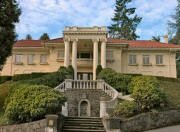
Aaron H. Maegly House
circa 1915
This Prairie School style home was designed by architect
John V. Bennes. It is located at 226 SW Kingston Street.
|
Arlington
Heights
Arlington
Heights, one of Portland's most scenic neighborhoods, is near city
center, giving residents easy access to the spectacular Portland International
Rose Test Gardens and all of Washington Park (Hoyt Arboretum, Japanese Garden,
Oregon Zoo). Just a 5-minute drive from downtown, Arlington Heights
is a veritable museum of architectural styles. Ranging from Victorian
cottage to the latest contemporary dwellings, these homes are graced by
lovely gardens and spectacular views. This is an old neighborhood
with 60 percent of the homes built before 1939.
Arlington Heights is a small area (103 acres) with less
than 250 residents. Many of the streets offer a convenient access
to the ten miles of trails in the 183 acre Hoyt Arboretum. Walk to
the Japanese Gardens as well as to the Oregon Zoo. Arlington Heights
residents can walk to work (all downhill) and take the bus home. Some
even ride their bike to work. If you're up for it, you can hike down
to one of the many restaurants on Northwest 21st and 23rd Avenue and enjoy
an evening meal. You just have to remember the uphill walk home.
Zoo Bombers
On children's bikes that have been customized -banana
seats, swooping handle bars, mini-wheels - members of the "Zoo Bombers"
whoosh down SW Fairview Boulevard from the zoo and into the Arlington Heights
neighborhood. After passing through the neighborhood, they enter the Goose
Hollow neighborhood where they catch a ride on the MAX Light Rail line back
to the zoo and repeat their performance. It's downhill all the way
from the zoo to the Goose Hollow MAX stop - a drop of about 500 feet or
so in a two mile run.
The bombers' make their appearance every Sunday evening
and continue their rides well into the night. Arlington Heights residents
are divided about the disturbance that the bombers create but all are in
agreement that the noise (whooping and hollowing) the bombers make are upsetting.
Especially those that live on SW Fairview Boulevard.
You can catch a video of the bombers at
YouTube.
Origin of Name
Arlington Virginia, the home of Robert E. Lee.
More About Arlington Heights
Neighborhood Association Web Site The neighborhood
does not have a Web site but they have a
Yahoo Discussion Group. Join the group by sending an email to
Yahoo Discussion
Group.
Location of Neighborhood West of downtown - it takes about
5-6 minutes to cross I-405 and be downtown. A five minute drive to be in
the Northwest shopping area.
1Drive
Time to Downtown 8-9 minutes.
Topography Moderate to steep hills and winding streets. Mature
trees and woods.
Street and Sidewalks All the side streets are narrow and many
cars park partially on the sidewalks. Most of the streets have sidewalks
although the walks are narrow on the side streets.
2005 Livability Study 96.4% of Arlington Heights residents rated
their neighborhood "good" or "very good." See
Livability Study.
Public Transportation
Bus route
63 connects downtown with Washington Park and Arlington Heights.
No MAX light rail or streetcar lines in Arlington Heights. Residents living
on the west side of the neighborhood can walk over to the MAX light rail
stop at the Oregon Zoo and catch a ride to work. You have to walk
as Metro (regional government in charge of the Zoo and MAX) does not allow
commuters to park in the Zoo lots.
22000
Demographics Population: 691. Area in acres:
103. Average population density: 6 persons per acre (includes vacant
spaces). Number of households: 278. Diversity: 7.3% non-Caucasian.
3Crime
Stats for 2007 No violent crimes, six residential burglaries,
one motor vehicle theft. Total crimes per 1,000 people was 11.
4Shopping
and Services The only retail establishments are the Rose Garden
gift shop, Hoyt Arboretum gift shop, and the Japanese Garden gift shop.
If residents want to shop, it means getting into your car and driving a
few minutes to the Northwest District or downtown. Or you can do what
78-year-old Arlington Heights resident Annie does - she walks down to Trader
Joes or Fred Meyers, does her shopping and takes the number 63 bus back
home.
Eating Out Its means getting into the family car and driving
a few minutes to the Northwest District or downtown. If you're a walker,
you can make it down to the Northwest District (10-12 restaurants) in 15-20
minutes but it will take much longer to walk back as an elevation gain of
300 - 500 feet.
Parks
Washington Park (130 acres) includes the International Rose Garden.
The park includes restrooms, gift shop, picnic site/picnic tables, playground,
soccer field, stage, tennis courts, trails, and a splendid vista point overlooking
the city and Cascade Range. The
Japanese Garden
is just across the street from the Rose Garden.
Hoyt Arboretum (220 acres) offers ten miles of walking trails and adjoins
Washington Park. The
Oregon Zoo and the
Children's Museum
adjoin the arboretum on the west boundary.
Public Library You have to go downtown to the
Multnomah County Central
Library or to the Northwest District branch located at 2300 NW Thurman
Street. Both are a 7-8 minute drive.
Who Lives in Arlington Heights Married couples in their 30s
and upward, couples with teen-age children, about 20 percent of the households
have children under 18.
Cars in the Neighborhood View homes will have an luxury sedan
such as a Audi, BMW, Mercedes, or Volvo - the second car is an SUV.
Pickups are rare except for the local Chevy dealer - he has his choice for
the "Vehicle of the Day" and one occasion he will take a pickup off the
lot and drives it home. I counted five Toyota hybrids driving through
the neighborhood one day.
Schools Elementary school:
Ainsworth. Middle school:
West Sylvan Middle
School. High school:
Lincoln High School.
School Report Card Grades Elementary school: A.
Middle school: A. High school: A. Click
here for report card details.
Home Styles Cottage, English, Tudors, and a few ranch homes
built in the 50s and 60s. Stilt homes have been built on steep hills
in the last 20-30 years. In 2005 and 2006, 7-8 new homes have either
been built or in the process of being built.
5Arlington
Heights 2007 Home Prices
-
Average price for homes sold in the Arlington Heights
neighborhood in 2007: $813,782.
-
Median price for homes sold in the Arlington Heights
neighborhood in 2007: $750,000.
-
2007 price appreciation in the Arlington
Heights neighborhood: 24%.
-
5-year price appreciation in the Arlington Heights
neighborhood: 68%.
-
2007 metro area home prices: The average price
was $342,900 (6.3% appreciation from 2006) and the median price was
$290,000 (7.2% appreciation from 2006).
Please be aware that the above figures are subject
to error and are intended as guidelines only.
|
|
|
|
Forest Park
Built along a ridge just 20 minutes from downtown, Forest
Park is in the Northwest area of Portland. If you desire the "look
and feel" of a suburban community but want to be close to downtown, examine
the Forest Park neighborhood closely.
Diversity in homes styles and sizes are the attraction.
Single-family homes from under 2,000 square foot townhomes to 5,000 plus
square foot detached single-family homes can be found in Forest Park.
Most have been constructed in the last ten years and the area is still being
developed. Many of the homes have views of the coast range
to the West and are within walking distance of the 5,127 acre Forest Park
which is on the east side of the elongated neighborhood (about 5 miles in
length).
Schools
Forest Park is a great place to bring up a family as
some of the best schools in Oregon are located in the neighborhood.
For example, the Forest Park Elementary has been rated "exceptional"
since 2004. See the latest State of Oregon
Department of Education Report Cards.
Forest Park
Portland's Forest Park is the 14th largest city park
in the United States. Covering 5,000 plus acres, it provides a hushed and
peaceful environment of a varied and evolving forest ecosystem. Overlooking
the Willamette River, the Park stretches for nearly eight miles along the
northeast slope of the Tualatin Mountains between NW Skyline Boulevard and
NW St. Helens Road (Hwy. 30).
Forest Park is home to over 100 species of mammals:
more than 100 kinds of birds have been seen in the Park. In the spring,
hillsides sparkle with trilliums amidst the sword ferns; hundreds of other
kinds of flowers and shrubs bloom during the year.
The Park offers enjoyment to hikers, bicyclists, runners,
and others who just enjoy being outdoors in a forest atmosphere. The 30+
mile long Wildwood Trail (a National Recreational Trail) traverses the Park
from the Vietnam Veterans' Memorial in Hoyt Arboretum to Newberry Road.
A total of more than 70 miles of interconnecting trails and lanes provide
opportunities for circle hikes of varying length.
See the
Friends of
Forest Park for more information.
Forest Heights
The 600 acre development is located to the southwest
of the Forest Park neighborhood - it is in Washington County. It is
commonly referred to as the "Intel Country Club" because so many of the
Intel engineers who work in Hillsboro live in Forest Heights. This
is the area with more diverse styles of homes to include townhomes and condos
along with detached single-family homes.
More About Forest Park
Neighborhood Association
Web Site The neighborhood does not have a Web site.
Location of Neighborhood West Burnside (turns into Barnes Road
after leaving the downtown area) to NW Skyline Road.
1Drive
Time to Downtown 18-19 minutes.
Topography Moderate to very hilly. It is a heavily wooded
area and many homes have views of the Coastal Mountain Range.
Streets and Sidewalks Void of sidewalks except along Miller
Road in Forest Heights. The streets leading to the developments can be winding
and narrow.
2005 Livability Study 96% of Forest Park Heights residents
rated their neighborhood "good" or "very good." See
Livability Study.
Public Transportation Forest Park has two two bus routes -
visit the TriMet Web
site. No MAX light rail or streetcar lines in Forest Park.
22000
Demographics Population: 2,360 people. Area (acres): 6,996.
Average population density: 3 persons per acre. Number of households: 859. Homeowners versus renters: 91 percent owners. Diversity:
7.4%. non-Caucasian.
3Crime
Stats for 2007 No violent crimes, 7 residential burglaries,
and 53 auto thefts. Total crimes per 1,000 people was 10.
4Shopping
and Services
These neighborhood is void of any retail establishments but it is a short
drive to a small mall (corner of SW Barnes Road and NW Miller Road)
with a QFC supermarket, Starbucks, cleaners, pizza, vet, etc. Residents
are about 10-15 minutes from the Northwest District as well as a larger
mall just off NW Cornell Road. In Forest Heights (southwest of the neighborhood),
the area's first commercial site is been developed at NW Miller Road and
NW Mill Ridge. It has a grocer and Starbucks.
Eating Out The Skyline Restaurant is located at 1313 NW Skyline
Boulevard and it attracts locals and outsiders. The Skyline is reasonably
price but don't expect gourmet food. For an evening meal, the closest
food source is the Outback Steakhouse at 11146 SW Barnes Road.
Parks The 5,000 plus acre Forest Park has more than 70 miles of
interconnecting trails and lanes that provide opportunities for circle hikes
of varying lengths.
Public Library You have to go downtown to the
Multnomah County Central
Library or to the Northwest District branch located at 2300 NW Thurman
Street.
Who Lives in Forest Park Young professionals who usually are married.
Only 14.4 percent of the households have one person living in them.
Cars in the Neighborhood Safe family cars. The second
car is usually a SUV or a sporty car for Dad to drive to work.
Schools Elementary school:
Forest Park. Middle school:
West Sylvan Middle
School. High school:
Lincoln High School.
School Report Card Grades Elementary schools: A/B.
Middle schools: A/B. High schools: A/B. Click
here for report card details.
Home Styles Almost exclusive contemporary homes. Most of
the home have been built in the last ten years.
5Forest
Park 2007 Home Prices
-
Average price for homes sold in the Forest
Park neighborhood in 2007: $819,998.
-
Median price for homes sold in the Forest Park neighborhood
in 2007: $762,500.
-
2007 price appreciation in the Forest Park neighborhood:
7%.
-
5-year price appreciation in the Forest Park neighborhood:
78%.
-
2007 metro area home prices: The average
price was $342,900 (6.3% appreciation from 2006) and the median
price was $290,000 (7.2% appreciation from 2006).
Please be aware that the
above figures are subject to error and are intended as guidelines only.
|

View
Forest Park Homes
for Sale
Forest Park Homes for Sale
North Forest Park Homes for Sale
Forest Park Boundaries
The boundaries
of this 6,996 acre neighborhood can best be described as that area
to the east of the 5,127 acre Portland Forest Park to include the park itself.
The south boundary is roughly along NW Cornell Road. The east boundary
appears as a series of steps following the county line between Multnomah
and Washington counties. The north boundary is the north end of Multnomah
County.
Maps of
Forest Park Neighborhood

Click to enlarge
Map Showing Neighborhood Boundaries
Forest Park
Google Maps
Forest Park
West Hills Parks
West Hills
Parks
Learn More About
the
Forest Park Neighborhood


This is a typical home in Forest Park that was on the market
in early March 2005 for $599,000. It has a 3-car garage and over 3,500
square feet of living space. It has hardwood floors, cherry cabinets, granite
countertops, stainless appliances, wainscoting, crown moldings, three fireplaces,
and a large master suite..
|
|
|
|

View
Hillside Homes
for Sale
Hillside Homes for Sale
Hillside Boundaries
North: NW Cornell Road.
South: West Burnside Street.
East: NW Westover Road.
West: Macleay Park.
Maps of
Hillside Neighborhood

Click to enlarge
Map Showing Neighborhood Boundaries
Hillside
Google Maps
Hillside
West Hills Parks
West Hills
Parks
Learn More About
the
Hillside Neighborhood


The Pittock Mansion was home to Portland pioneers Henry and Georgiana Pittock
from 1914 to 1919. During the late 1800s and the early 1900s, their lives
and work paralleled the growth of Portland from a small Northwest town site
to a thriving city with a quarter million population. With its eclectic
architectural design and richly decorated interior, including family artifacts,
the Pittock Mansion stands today as a living memorial of this family's contributions
to the blossoming of Portland and its people.
|
Hillside
(Aka Kings Heights)
The
promoters of the original Westover development called the area "the finest
residential section in the United States." The Westover developers'
plan to terrace the hill, then known as "Scotch Nubbin", so that they could
build homes. The area was completed in 1914, and since then the neighborhood
has grown to approximately 575 households.
Hillside Community Centerr
This facilities includes classrooms, gymnasium, tennis
courts, soccer field, outside play area, kitchen, and office.
The story of how the Community Center started tells
one a lot about the character of the neighborhood.
Owned by an art school who could not afford its upkeep,
the building was about to be sold to developers. Residents felt that
the site would be better used as a park and community center. The problem,
of course, was money. The community was given a year to raise $106,500 to
purchase the land and the buildings on it. After an exhaustive neighborhood
fundraising effort, plus contributions from the City Council and private
foundations, the community was still $25,000 short.
To make up the difference, twelve families took out
second mortgages on their homes to guarantee the loan that finalized the
purchase. This group was known as the 'Trembling Twelve.' In spring of 1974,
the neighbors turned the property over to the City of Portland, which accepted
it as a public park and agreed to maintain it and staff a community center
there.
More About Hillside
Hillside Neighborhood Association Web Site
Visit the
Hillside
Neighborhood Association to learn more about the neighborhood.
Location of Neighborhood Look directly West into the hills
while shopping and browsing along NW 23rd Avenue and you're see the Hillside
neighborhood.
1Drive
Time to Downtown Ten minutes. Topography Winding
roads that go up and down - very hilly. Mature trees in yards in parks.
Streets and Sidewalks Most of the streets are narrow and winding.
Sidewalks are fairly common.
2005 Livability Study 96% of Hillside residents rated their
neighborhood "good" or "very good." See
Livability Study.
Public Transportation
TriMet serves the
Hillside neighborhood with two bus routes. No MAX light rail or streetcar
lines in Hillside.
22000
Demographics Population: 1,285 persons. Area (acres):
300. Average population density: 2.24 persons per acre. Number
of households: 575. Homeowners versus renters: 95 percent owners.
Diversity: 3% non-Caucasian.
Crime Stats for 2007 Two violent crimes, 4 residential
burglaries, and 16 auto thefts. Total crimes per 1,000 people was
7.
44Shopping
and Services Hillside does not have any services in the neighborhood.
Just minutes away in the Northwest District, Hillside residents can shop
at a large supermarket along with numerous specialty shops. Besides
the large food markets such as Zupan's and Fred Meyers, Northwest residents
shop at Trader Joe's on NW Glisan Street, City Market on NW 21st Avenue,
and Elephant's Delicatessen just off West Burnside. It also has a couple
of good bakeries along with a meat market.
Eating Out It all lies at the bottom of the hills and just
minutes from the homes. The Norwest District offers 10-12 restaurants.
Parks
Visit Pittock Mansion to enjoy a view of the city and Cascade Range..
Public Library The closest library is the
Northwest District Branch
located at 2300 NW Thurman Street.
Who Lives in Hillside The 'Movers and Shakers' of Portland.
See the "Average Price" below.
Cars in the Neighborhood Audis, BMWs, Mercedes, and other luxury
autos along with a second car which is usually a SUV.
Schools Elementary school:
Chapman. Middle school:
West Sylvan Middle
School. High school:
Lincoln High School.
School Report Card Grades Elementary school: B.
Middle school: A. High school: A.
Click
here for report card details.
Home Styles English Tudor, Queen Ann Victorian, Colonial, Foursquare.
Contemporary homes that are built on steep lots using modern building technology
are evident.
5Hillside 2007 home prices
-
Average price for homes sold in the Hillside
neighborhood in 2007: $891,311.
-
Median price for homes sold in the Hillside neighborhood
in 2007: $740,000.
-
2007 price appreciation in the Hillside neighborhood:
16%.
-
5-year price appreciation in the Hillside neighborhood:
28%.
-
2007 metro area home prices: The average
price was $342,900 (6.3% appreciation from 2006) and the median
price was $290,000 (7.2% appreciation from 2006).
Please be aware that the above figures are subject
to error and are intended as guidelines only.
|
|
|
|
Southwest Hills: Council
Crest and Portland Heights
The Southwest Hills neighborhood includes
Portland Heights and Council Crest, an area where John B. Talbot first claimed
land in 1851. An amusement park was built on Council Crest in 1907 and continued
operation until 1929. The city bought the land in 1936 and created Council
Crest Park. Portland Heights first saw extensive development with the advent
of streetcar lines up the hill. Further access was provided by the Fourth
Street Bridge, which was replaced in 1926 by the Vista Avenue Bridge.
Southwest Hills homes have two attractions: downtown
is only a short drive away and many of the homes have spectacular views.
Views include the Cascade mountain range, Willamette River, and downtown,
such as the photo above. When you have a view of more than one mountain,
such as Mt. Hood and St. Helens, it's called a two-mountain view.
When these homes go on the market, the ad reads, "mountain view during the
day and city view at night."
Council Crest is the highest point in the metro area
at 1,071 feet above sea level. On a clear day, the view from Council
Crest is unbeatable. Visitors who can see Mt. Hood (about 40 miles
to the east) and Mt. Rainer at more than 100 miles to the north.
Origin of Name
Council Crest got its name in 1898 from a group of delegates
to a Congregational Church council who climbed the 1,071-foot hill and promptly
named it after their gathering.
More About Southwest Hills
Neighborhood Association
Web Site The neighborhood does not have a Web site. Take a historical
tour of homes on Montgomery
Avenue (PDF format).
Location of Neighborhood Southwest of downtown. Get on Southwest
Vista and take a tour of the neighborhood. See
Southwest
Hills in PDF format.
1Drive
Time to Downtown 12-13 minutes.
Topography Moderate hilly in Portland Heights and quite hilly
in Council Crest. Mature trees in yards in parks.
Street and Sidewalks Many of the side streets are narrow.
All of Portland Heights have walkable sidewalks whereas Council Crest have
a few sidewalks.
2005 Livability Study 96% of Southwest Hills residents rated
their neighborhood "good" or "very good." Healy Heights was combined with
Southwest Hills in the study. See
Livability Study.
Public Transportation A number of bus routes connects the Southwest
Hills with the rest of Portland. See the
Vista
- 51 at the TriMet Web site.
22000
Demographics Population: 4,673 Persons. Area (acres): 1,310.
Average population density: 3 persons per acre. Number of households: 1,992. Homeowners versus renters: 84 percent owners. Diversity: 5.6% non-Caucasian.
3Crime
Stats for 2007 one violent crimes, 11 residential burglaries,
and 78 auto thefts. Total crimes per 1,000 people was 24.
4Shopping
and Services Number of supermarkets: 1. Number of hardware stores:
0. Number of coffee shops: 0.
Stroheckers,
a landmark store for many of the residents needs includes; groceries, deli,
pharmacy, and liquor. Stroheckers is located at 2855 SW Patton Avenue.
Eating Out One restaurant and it's worth a stop - the Vista
Spring Cafe located at the intersection of SW Vista Street and SW
Spring.
Who Lives in the Southwest Hills Well established people!
The median income in 1990 was $66,849. Only 16% of the population
were renters in 1996.
Cars in the Neighborhood Expensive real estate so you'll see
expensive cars to include Audis, BMWs, Mercedes, and other luxury autos
along with a second car which is usually a SUV.
Schools Elementary school:
Ainsworth. Middle school:
West Sylvan Middle
School. High school:
Lincoln High School.
School Report Card Grades Elementary school: A.
Middle schools: A/B. High schools: A/D. Click
here for report card details.
Home Styles English Tudor, Queen Ann Victorian, and Colonial.
You will see a few contemporary homes that are built on steep lots
using modern building technology.
5Southwest Hills 2007 home prices
-
Average price for homes
sold in the Southwest Hills neighborhood in 2007: $877.421.
-
Median price for homes sold
in the Southwest Hills neighborhood in 2007: $755,000.
-
2007 price appreciation
in the Southwest Hills neighborhood: 17.
-
5-year price appreciation
in the Southwest Hills neighborhood: 48%.
-
2007 metro area home prices:
The average price was $342,900 (6.3% appreciation from 2006) and the
median price was $290,000 (7.2% appreciation from 2006).
Please be aware that the
above figures are subject to error and are intended as guidelines only.
|

View
Southwest Hills Homes
for Sale
Southwest Hills Homes for Sale
Southwest Hills Boundaries
North: Highway 26 (Sunset Highway).
South: Southwest Patton Road on the west end and Southwest Broadway
on the east.
East: I-405.
West: Southwest Scholls Ferry Road.
Maps of
Southwest Hills Neighborhood

Click to enlarge
Map Showing Neighborhood Boundaries
Southwest
Hills
Google Maps
Southwest Hills
West Hills Parks
West Hills
Parks
Learn More About
the
Southwest Hills Neighborhood

View of Downtown from
Portland Heights

|
|
1Drive
Time to Downtown Estimated commuting time obtained from Yahoo
Maps and Google Maps. Drive time was calculated from a central intersection
in each neighborhood to Pioneer Courthouse Square during the morning peak
commute time.
2Demographics Data
Numbers were obtained
from Census 2000 and
www.portlandmaps.com.
3Crime Statistics Numbers on crime represent
total crimes for 2007 and were obtained from county sheriff departments
and the Oregon State Police. Violent crimes are defined as murder,
rape, and aggravated assault.
4Shopping
and Services Numbers were determined from local directory listings
and county/municipal library systems.
5Real
Estate Values Data on real estate values provided by Graphical
Data, Homequest, and RMLS™.
|
|